


Horticultural fleeces now being tested in appellation areas in France


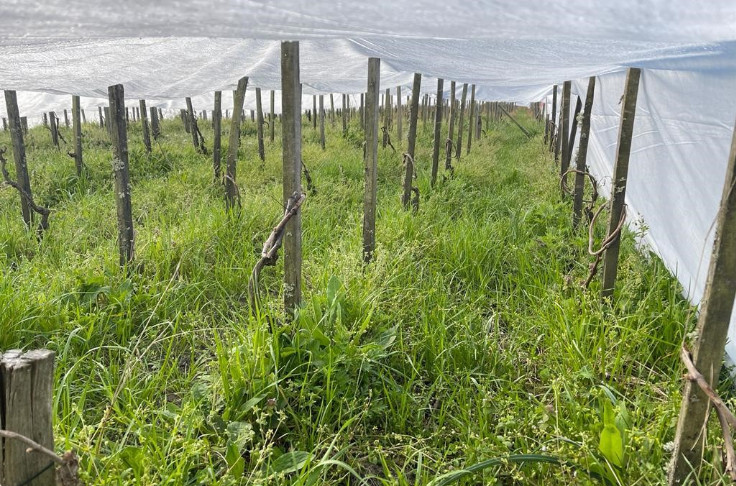
ould fleeces be the future for vines in a changing climate? “They are 100 % effective [against frost], and 100 % forbidden [in appellation areas]!” comments Bordeaux winegrower Loïc Pasquet. The owner of Domaine Liber Pater in Graves, Pasquet also produces wines outside the appellation area and with his now customary impertinence, he sums up the positive outcome of his trial of P30 horticultural fleeces over 5 hectares of his vineyards from Thursday 31 March to Tuesday 5 April. Pasquet says that, thanks to the fleeces, his vines did not suffer the damage that would have devastated the buds due to temperatures plummeting to as low as -5.4°C on Sunday 3 April. The burnt buds in the 0.3 hectare block he did not cover are there to prove it.
After suffering severe crop losses due to frost in 2021, Pasquet believes that the winter covering “is the most economical and sustainable solution”. The fleece he used costs 2,000 euros/hectare, and can be re-used; usually it is placed on a frame, but this was not the case at Liber Pater. “The fleeces are there to correct an anomaly caused by global warming. During the day it is cold, the ends are open and air circulates. There is no impact on the vegetative stage, but there is total impact on frost. The priority is to save the plant material (because vines end up dying due to frost),” explains Pasquet. He adds: “We install the fleeces for the duration of the frost and they are removed within a day”. This is a good argument for allowing the technique to be used in appellation areas, and it is apparently more effective and less costly than candles and tower wind turbines.
Although the use of horticultural fleeces is forbidden for AOCs, the National Committee for Wine Appellations of Origin at the National Institute of Origin and Quality (INAO) told Vitisphere that “the relevant regulations have become obsolete and need to be updated in light of innovations in equipment and changes in the regulatory context and, particularly, the weather”. INAO is currently working on proposals for change and has tasked its scientific and technical panel with a mission “to examine the issue of protecting vines against freak weather, without altering the bond with terroir and therefore between AOCs and the climate. As part of the regulatory and technical examination of protection systems to combat adverse weather, four experiments are underway on vine covering systems (Chablis, Touraine, Savoy and Bordeaux)”.




 Facebook
 Twitter
 LinkedIn